AI stocks had a bad day, and boring stocks had a great one.
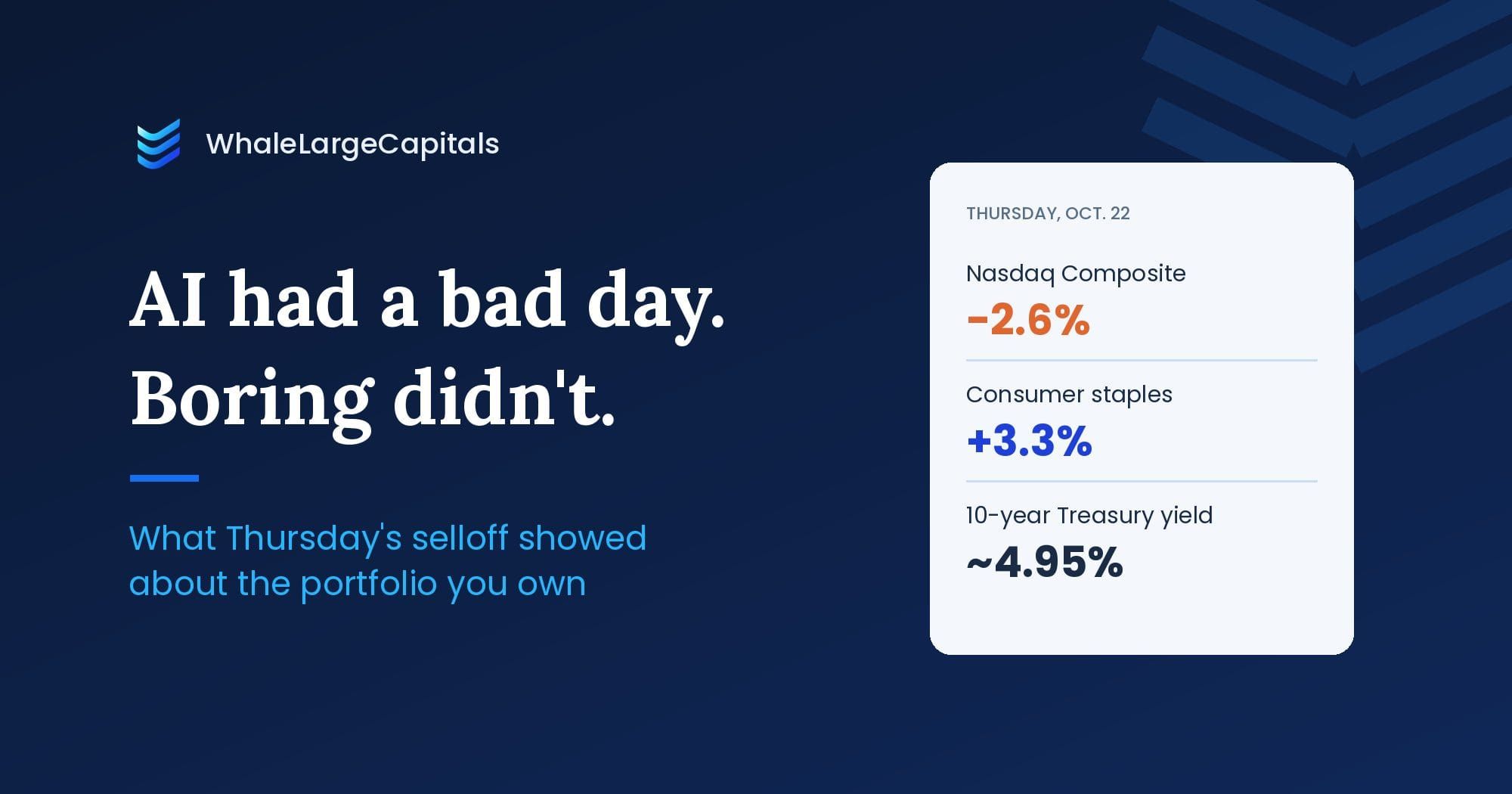

AI stocks had a bad day, and boring stocks had a great one.
Chip stocks fell almost 7% on Thursday while consumer staples rose 3% and bonds rallied. Here is what that tells you about the mix in your 401(k).
WhaleLargeCapitals. Think like a whale. Get paid first.
The Morning Letter Friday, October 23, 2026
Morning briefing

AI stocks had a bad day. Boring stocks had a great one.

By Paul Haull. 6-minute read.

Good morning.

On Thursday, the market gave its verdict on what we discussed in yesterday's letter. Investors read Meta's spending plans, didn't like them, and sold technology hard. If you only watched the Nasdaq, it looked like a rout. But two-thirds of the stocks in the S&P 500 went up, and the dullest corners of the market had a very good day. This morning I'll show you what really happened, and what it tells you about the mix in your own 401(k).

What happened

The selloff: the Nasdaq fell 2.6%, its worst day since June, and the S&P 500 lost 1.2%. Chip stocks dropped 6.7%. Meta fell about 7% after its earnings.

The other side: the Dow finished flat. Consumer staples stocks rose more than 3%, and utilities, health care and financials also gained.

Bonds: the 10-year Treasury yield fell to about 4.95%, its biggest one-day drop in more than two years. Falling yields mean rising bond prices.

Read the full market recap

1 of 3

The index fell. The average stock rose.

Most popular index funds are weighted by company size, so a handful of giant technology stocks drive the daily number. When those giants fall, the headline index falls with them, even if most other companies are doing fine.

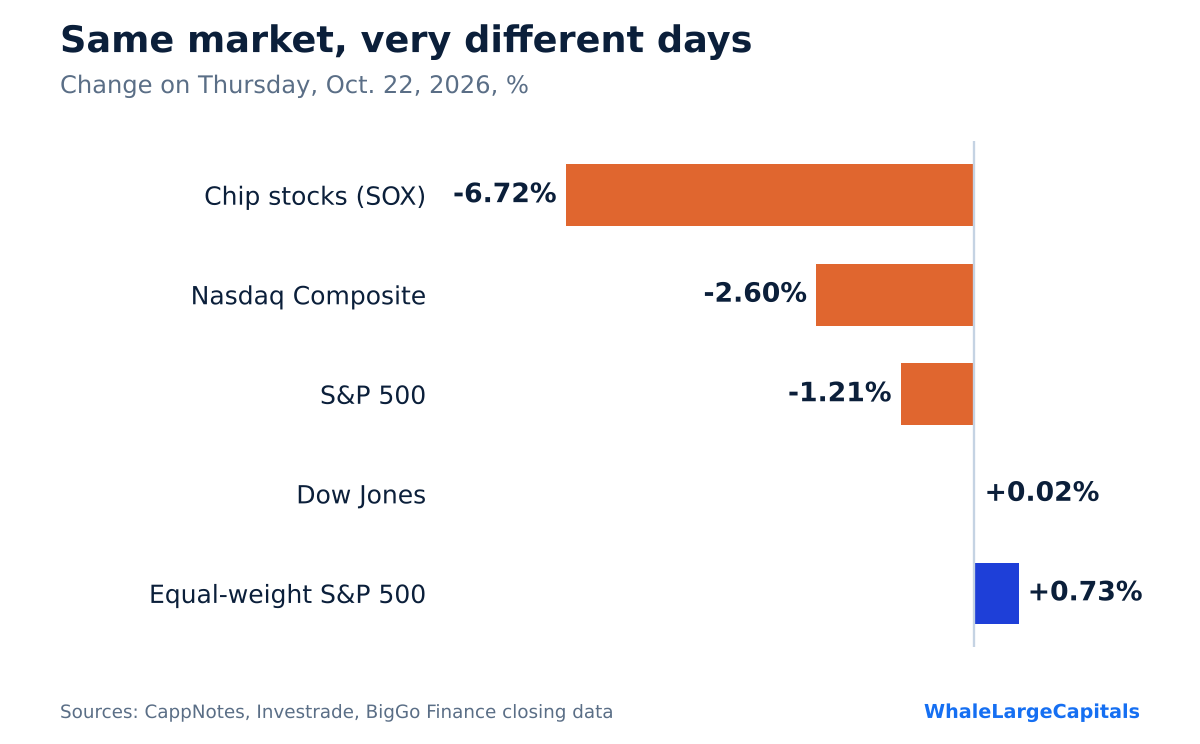
Thursday made that unusually visible. The equal-weight version of the S&P 500, which gives every company the same slice, rose while the regular index fell. One reading of "the market" said down 1.2%. Another said up 0.7%.

Chart: change on October 22, 2026: chip stocks (SOX) down 6.72%, Nasdaq Composite down 2.60%, S&P 500 down 1.21%, Dow Jones up 0.02%, equal-weight S&P 500 up 0.73%

How to read this: each bar is how one slice of the stock market moved on the same day. The closer a measure leans toward big technology companies, the worse it did. The one that treats every company equally finished up.

That's not a reason to abandon your index fund. It's a reminder of what it is: a big bet on the biggest companies, which this year means a big bet on artificial intelligence.

Paul's rule

You don't find out what you own on good days. You find out on days like Thursday.

2 of 3

Where the money went

Money that left technology didn't disappear. It moved into companies that sell things people buy no matter what: groceries, household goods, electricity, medicine. Investors call this a rotation into "defensive" stocks.

The irony is that the week before, investors had poured record amounts into chip-stock funds. Many of them bought near the top of the run and absorbed the full 6.7% drop.

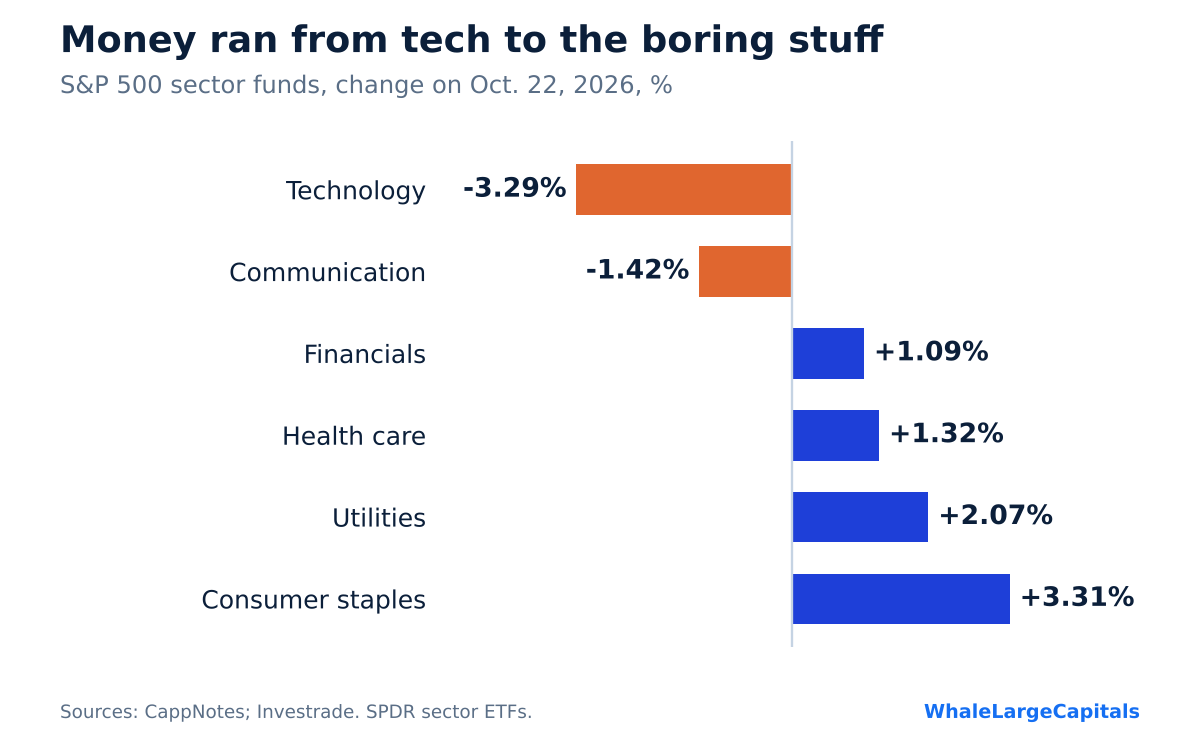
Chart: S&P 500 sector funds on October 22, 2026: technology down 3.29%, communication down 1.42%, financials up 1.09%, health care up 1.32%, utilities up 2.07%, consumer staples up 3.31%

How to read this: each bar is one sector of the S&P 500 on the same day. Orange sectors fell, blue ones rose. A portfolio holding a bit of everything would have felt far less pain than one concentrated at the top.

And bonds did their job. On Thursday, as stocks fell, Treasuries rallied. That's the cushion a balanced portfolio is supposed to provide.

The Fine Print

If your 401(k) is in a target date fund, it holds a mix of stocks and bonds that becomes more conservative as the date nears. The SEC calls that schedule the "glide path."

Its investor bulletin carries a warning most savers never read: "Even target date funds with the same target date often have very different investments and different performance/returns." Two 2050 funds can hold very different amounts of stock.

Read the SEC bulletin

3 of 3

One day isn't a trend. Your mix is.

Don't read too much into a single session. Tech has rebounded from sharp drops many times, and the AI story isn't settled in either direction. Oil also played a part: Brent crude closed above $113, its highest since May, on new attacks around the Strait of Hormuz.

The useful question isn't "should I sell tech?" It's "how much of my money moved like the Nasdaq yesterday, and is that the amount I chose?" If you're 35, a big tilt toward growth can make sense. If you're 58 and plan to retire in a few years, Thursday is a preview of what that tilt can feel like when you can't afford to wait.

Test yourself: who moved up the line?

On a rotation day, the winners are the ones who were already spread out.

Front of the line

Investors with a set mix of stocks and bonds who rebalance on a schedule

Holders of consumer staples, utilities and health care, the sectors that rose

Treasury holders, whose bonds rose in value as yields fell

Back of the line

Investors who poured money into chip funds last week

Portfolios that hold the same tech giants through several funds

People near retirement with more in stocks than they realize

The Protocol

Four moves to make this week

1

Check Thursday's damage. Log in and see how much your accounts moved. Compare it with the S&P 500's 1.2% drop. If you fell much more, you're tilted toward tech, whether you meant to be or not.

2

Look up your target date fund's stock share. It's on the fund's fact sheet. Ask whether that percentage fits how soon you'll need the money.

3

Write down your target mix. Pick the split between stocks and bonds you actually want, and put a rebalancing date on your calendar. Then you won't have to decide anything on a day like Thursday.

4

Keep contributing. If you're adding to a 401(k) every paycheck, down days buy more shares at lower prices. Don't stop your contributions because of one bad afternoon.

Liquidation Value: reacting to a rotation day

What it costs to chase yesterday's winners or dump yesterday's losers.

Bad timing. Selling after a 6.7% drop and buying after a 3% jump means doing both trades at the wrong price.

Taxes. Selling winners in a taxable account triggers capital gains. Inside a 401(k) or IRA, rebalancing is tax-free.

Missed rebounds. Tech has bounced back from sharp single-day drops before. Selling locks in the loss.

Defensive isn't risk-free. Staples and utilities can lag for years when growth is in favor.

I'm wrong if this is the start of a longer shift away from AI stocks. Then a bigger move toward balance now will look smart, and waiting will have cost you.

The Boardroom

A question I get a lot: should I switch to an equal-weight fund?

Not wholesale. Equal-weight funds spread your money more evenly, which helped on Thursday. But they've lagged the regular index badly in years when the giants led, and they often cost more and trade more.

A middle path works for many people: keep your core index fund, and add a smaller slice of something that behaves differently, whether that's an equal-weight fund, a dividend fund or simply more bonds. The goal isn't to win every day. It's to make sure no single day can do real damage to your plan.

That's it for this morning. Have a good weekend. Before Monday, look at how your accounts moved on Thursday. That one number tells you more about your real risk than any questionnaire.

Paul Haull