|
| The Morning Letter |
Friday, November 6, 2026 |
|
Morning briefing
The worst day for stocks since April 2025. Here's what it did to your 401(k).
By Paul Haull. 6-minute read.
|
|
Good morning.
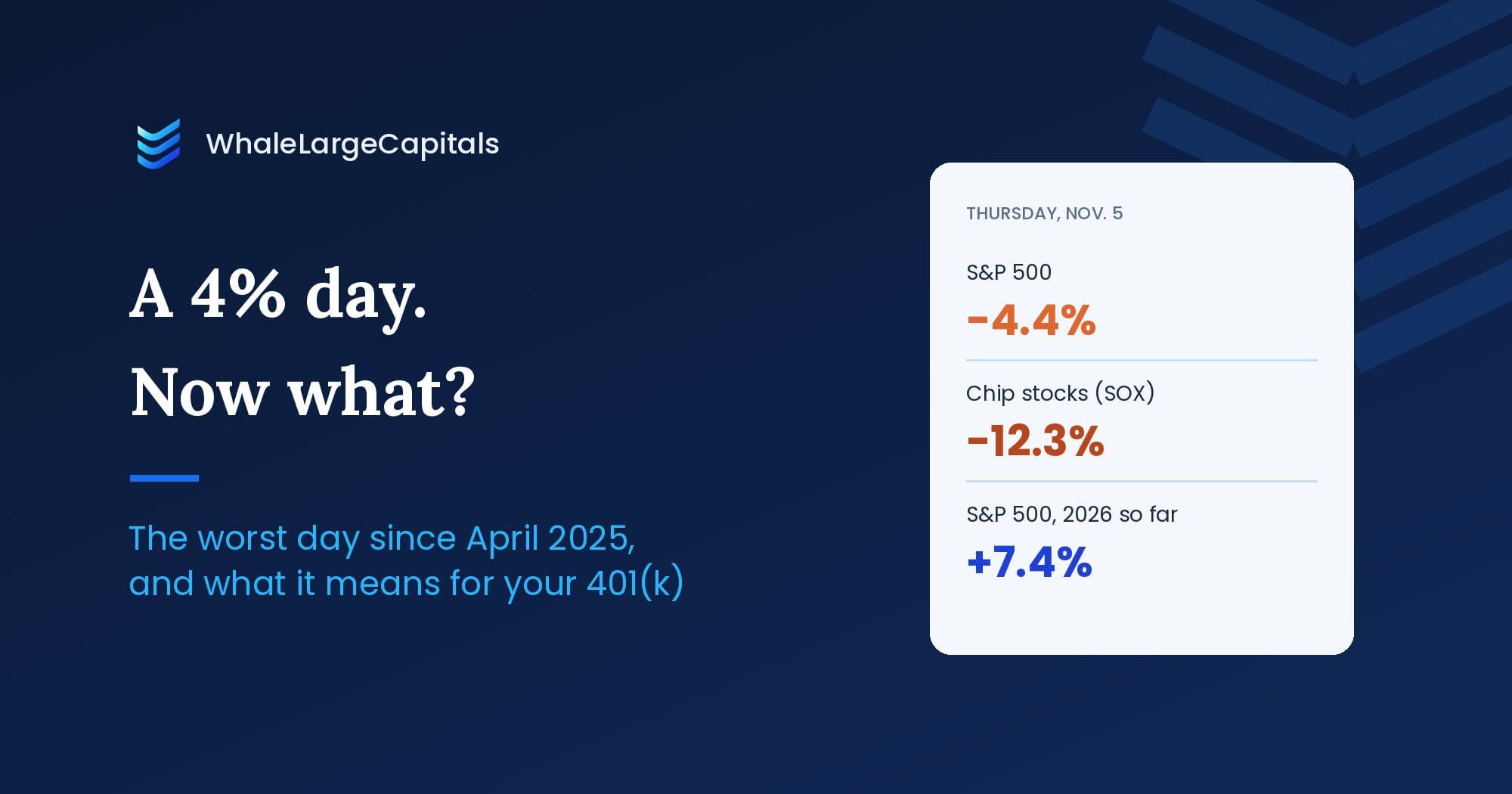
Yesterday the S&P 500 fell 4.4%. The Dow lost more than 1,800 points. It was the worst day for the broad market since April 2025, when tariffs rattled Wall Street. If you opened your retirement account last night, you saw it. This morning I'll put the drop in dollars, explain what drove it, and show where the market actually stands for the year, which is better than the headlines make it sound.
|
|
What happened
The drop: the S&P 500 closed at 7,353.73, down 4.4%. The Nasdaq composite fell 5.5% and is now 11.9% below its record, in correction territory. The Dow fell 3.4%. Wednesday's rally, the best day in three months, was more than erased.
The epicenter: chip stocks. An index of semiconductor companies fell more than 12%. AMD lost 17.3%, Micron 17.5% and Nvidia 9.3%. Wall Street's fear gauge, the VIX, jumped nearly 70%.
The reason: worries that construction of new AI data centers could slow. Borrowing costs have risen, and after Tuesday's elections, investors see a higher chance of local limits on new data centers. Voters across parties have grown wary of them and of the higher power bills tied to them.
Read the AP report
|
|
|
1 of 3
A chip crash that dragged everything down
This was not a day when everything fell equally. Chip stocks took the worst of it. The Nasdaq, packed with tech, fell more than the S&P 500. The Dow, with fewer tech giants, fell the least of the three. Gold rose slightly.
|
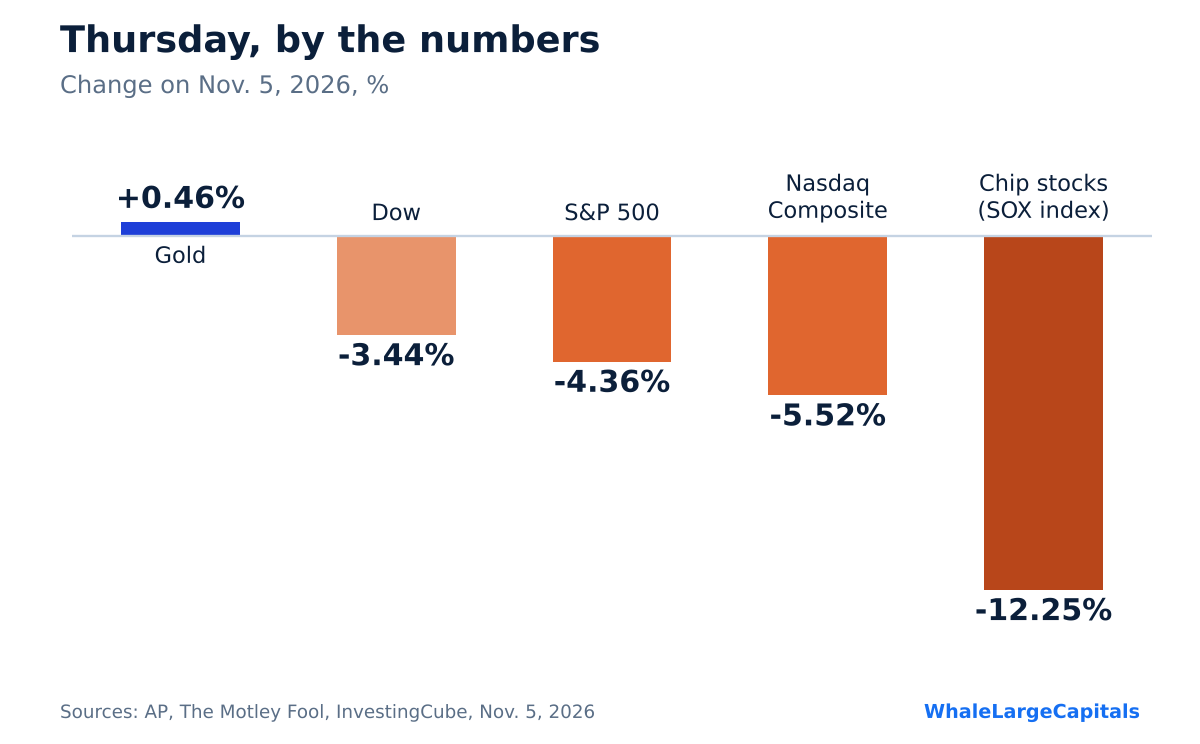
How to read this: each bar is one market's move on Thursday. The further right you go, the more the index depends on chipmakers and AI, and the bigger the drop.
|
|
|
The reason the whole market fell so hard is weight. The biggest tech and chip companies make up a large share of the S&P 500, so when they drop together, they pull the index down with them. That's the hidden cost of an index fund dominated by a few giants.
|
|
Paul's rule
Your mix of stocks and bonds decides how bad a bad day feels. Choose it on a calm day.
|
|
|
2 of 3
What 4.4% looks like in dollars
Percentages hide the pain. Take a $200,000 retirement account. If it was all in stocks that moved like the S&P 500, it lost about $8,700 in one day. With 40% in bonds, the loss was about $5,200. With 60% in bonds, about $3,500.
|
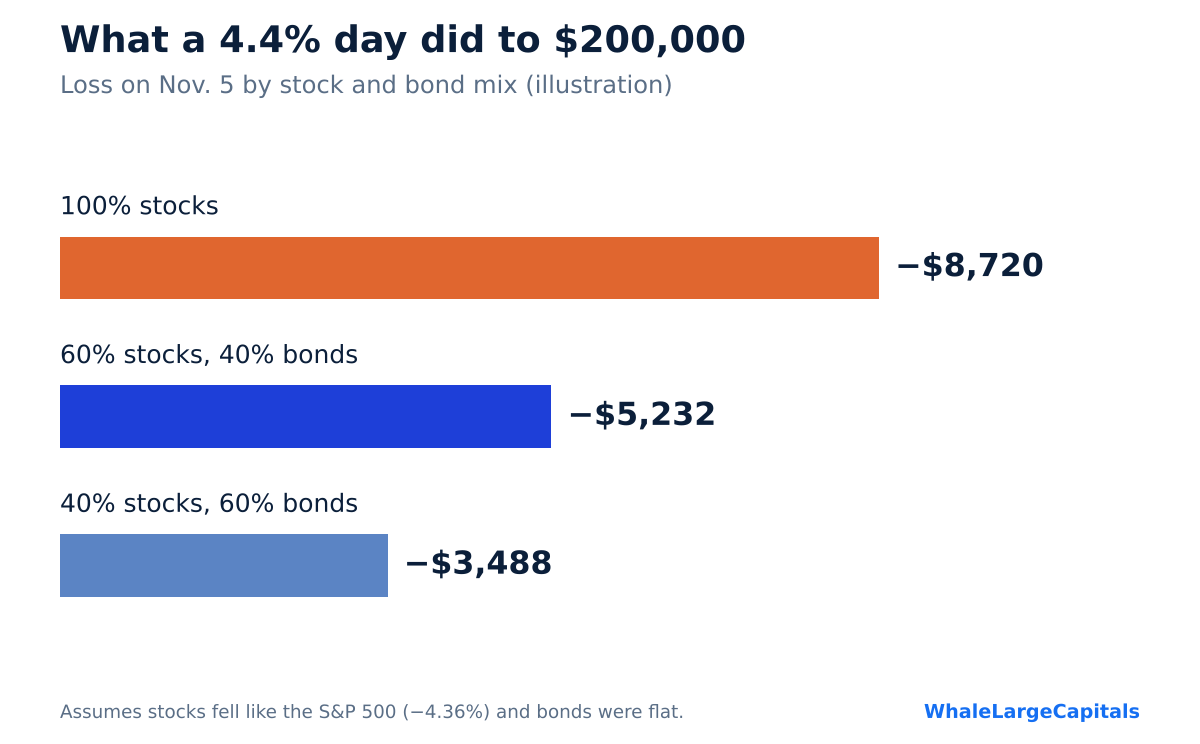
How to read this: each bar shows how much a $200,000 account would have lost on Thursday, depending on how much was in stocks. It assumes bonds didn't move. In fact, high-quality bonds helped a little: the 10-year Treasury yield fell, which pushes bond prices up.
|
|
|
Bonds did their job yesterday. The 10-year Treasury yield fell to 4.84% from 4.90%, and when yields fall, bond prices rise. A small gain, but in the right direction on the day you needed it.
|
|
The Fine Print
The market has emergency brakes, and yesterday didn't come close to them. Market-wide circuit breakers kick in when the S&P 500 falls 7%, 13% or 20% from the previous day's close.
According to FINRA, a 7% or 13% drop before 3:25 p.m. halts trading in all stocks for 15 minutes. A 20% drop at any time shuts trading for the rest of the day. Thursday's 4.4% fall was big, but it was an orderly sell-off, not a market breakdown.
Read FINRA's guide to circuit breakers
|
|
|
3 of 3
Where the market really stands
Zoom out from one day. Even after Thursday, the S&P 500 is up about 7.4% for 2026, measured from its year-end close of 6,845.50. It is about 6% below its October record. That's a pullback, not a crash.
Big down days are also more common than they feel. From 2017 through 2025, the S&P 500 fell 2% or more on 85 separate days. Over the same period, the index roughly tripled. Some of the market's best days came right after its worst ones, including Wednesday's rally two days ago.
Today brings the October jobs report at 8:30 a.m. Eastern. Economists expect modest hiring and a 4.2% unemployment rate. Futures were mixed early this morning. Expect more swings, in both directions.
|
Test yourself: who moved up the line?
On a 4% day, how you're set up matters more than what you do next.
|
Front of the line
Investors with a bond allocation matched to their age and goals
401(k) savers whose next paycheck buys shares about 6% cheaper than at the October high
Anyone who rebalanced out of tech after this year's big run
|
|
Back of the line
Investors heavily concentrated in chip stocks or AI funds
Anyone who needs to sell stocks this month to pay a bill
Investors who sell after a day like this and wait for things to feel safe
|
|
The Protocol
Four moves to make this week
| 1 | Do nothing today. Don't trade on the morning after a big drop, and don't trade on jobs-report morning. Decisions made in the first hours of a scary market are rarely the good ones. |
| 2 | Check your mix, not your balance. Look up your stock and bond split in each account. If a 4% day felt unbearable, your mix may be more aggressive than you can live with. |
| 3 | Separate near-term cash. Money you'll need in the next year or two, for a house, tuition or a car, shouldn't be in stocks. Move it gradually, not in a panic. |
| 4 | Adjust on a calm day. If you decide to shift toward more bonds, set the change for next week, inside your 401(k) or IRA where it won't trigger taxes. |
|
|
Liquidation Value: shifting more of your money into bonds
A calmer portfolio is a fair goal. It comes with a price.
Lower long-term growth. Over long periods, bonds have earned less than stocks. A safer mix usually means a smaller balance at retirement.
Selling low. Moving out of stocks right after a 4% drop locks in part of the loss.
Bonds can fall too. When rates rise, bond prices drop. That happened this year as the 10-year yield climbed above 5.3% last month.
Taxes outside retirement accounts. Selling stocks in a taxable account can trigger capital gains.
I'm wrong if the AI slowdown fears are right and this becomes a long decline. Then investors who shifted toward bonds early will be glad they did.
|
|
The Boardroom
A question I get a lot: is this the start of a crash?
Nobody can tell you that, and you should be wary of anyone who claims to. What we know: the S&P 500 is about 6% below its record and still up for the year. A bear market means a fall of 20% or more. We're far from that today.
The more useful question is personal: if this turned into a 20% drop, would you have to sell? If your near-term money is in cash and bonds, the answer is no, and you can wait it out. If the answer is yes, that's the thing to fix, not the market.
|
|
That's it for this morning, and for a rough week. Close the app, enjoy your weekend, and look at your plan on Monday with fresh eyes.
Paul Haull
|