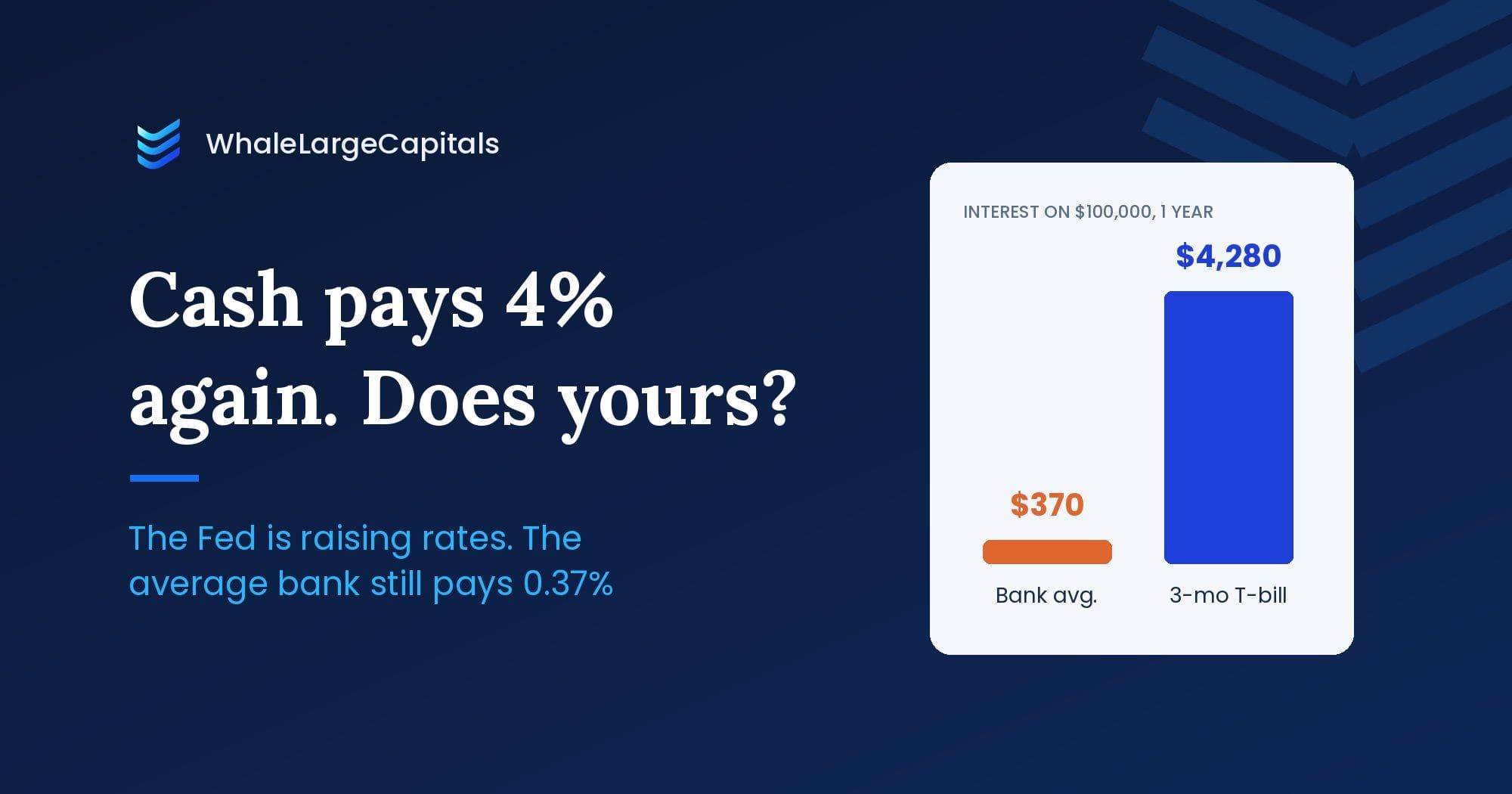
Cash pays over 4% again, but probably not at your bank.

Cash pays over 4% again, but probably not at your bank.
Treasury bills pay over 4%. The average savings account pays 0.37%. Here is how to stop handing your bank the difference.
WhaleLargeCapitals. Think like a whale. Get paid first.
The Morning Letter Friday, October 16, 2026
Morning briefing

Rates are going up. Your bank hasn't told you.

By Paul Haull. 6-minute read.

Good morning.

This week brought two hot inflation reports in a row, and Wall Street is now betting on the Federal Reserve raising rates again. Most of the commentary is about stocks and mortgages. I want to talk about the money most retirees never think about: the cash sitting in a savings account. When rates rise, someone collects the extra interest on it. This morning I'll show you how to make sure it's you, not your bank.

What happened

Wholesale prices: the producer price index rose 1.3% in September, the biggest monthly jump since March 2022, the Labor Department said Thursday. Over twelve months it's up 6.3%. Energy drove most of the September jump.

The Fed: it raised its benchmark rate to a range of 3.75% to 4% on September 16, its first hike since 2023. The next decision is on October 28.

The odds: after Wednesday's consumer price report, futures markets put the odds of an October hike at roughly 35% to 40%. Prediction markets see a December hike as likely.

Read the Labor Department release

1 of 3

What safe money pays right now

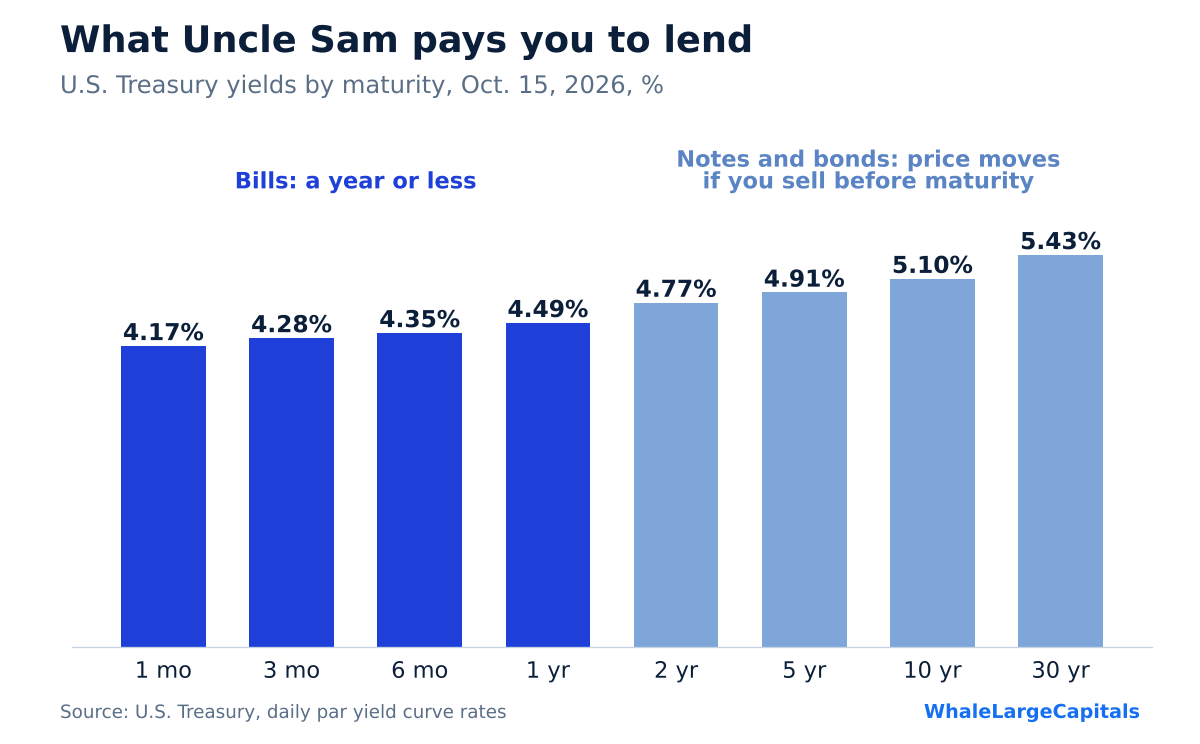
The cleanest measure of what cash is worth is what the U.S. government pays to borrow it. Lend Washington your money for three months and you get about 4.28% a year. Lend it for two years and you get about 4.77%.

Notice the shape. The longer you lock your money up, the more you're paid. That's how it's supposed to work, and it gives you a real choice between flexibility and a higher rate. We'll come back to that choice.

Chart: U.S. Treasury yields on October 15, 2026: 1 month 4.17%, 3 months 4.28%, 6 months 4.35%, 1 year 4.49%, 2 years 4.77%, 5 years 4.91%, 10 years 5.10%, 30 years 5.43%

How to read this: each bar is the yearly rate the Treasury pays for lending it money for that long. The dark bars are bills, which mature in a year or less. The pale bars are notes and bonds, whose price moves if you sell before they mature.

If the Fed hikes again, the short end of that chart tends to move up with it. Bills reset every few weeks or months, so they pick up a higher rate quickly. That's the good news for savers.

Paul's rule

Your cash always earns the market rate. The only question is who keeps it.

2 of 3

The bank keeps the difference

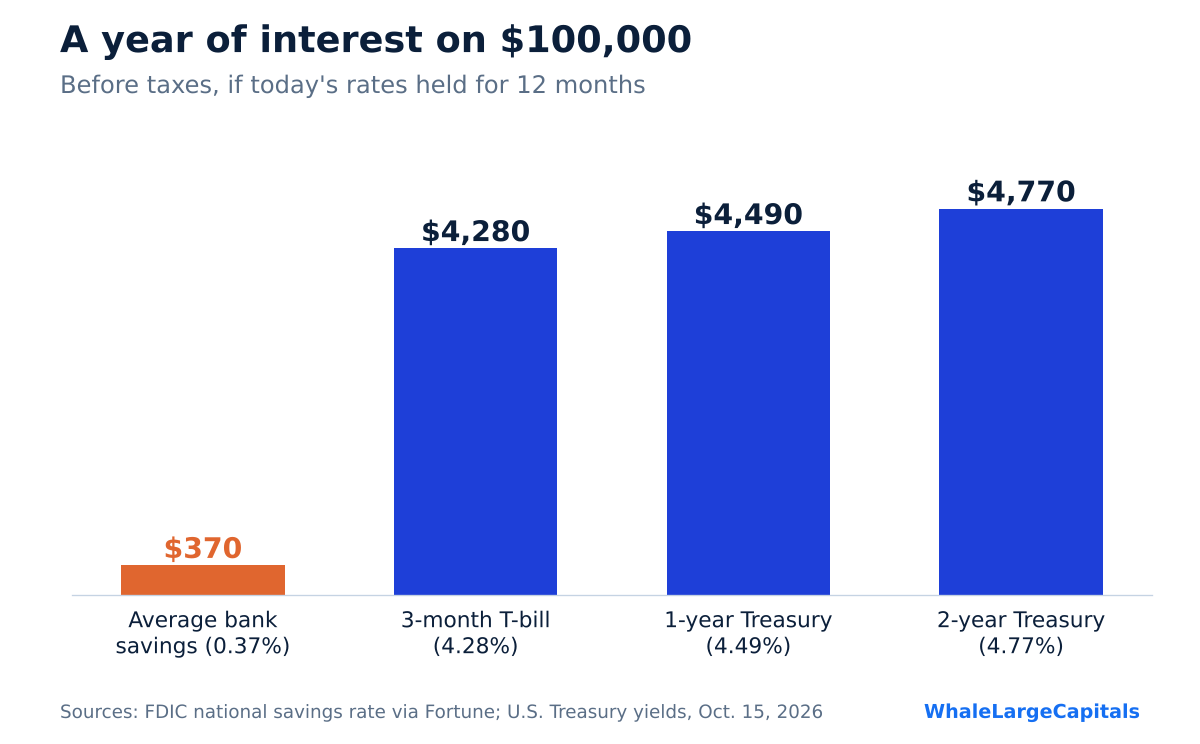
Here's the bad news. The national average rate on a savings account is 0.37%, according to the FDIC's latest figure. That's less than a tenth of what a three-month Treasury bill pays.

Your bank doesn't let that money sit idle. It lends it and invests it at market rates, and pays you whatever it needs to keep you from leaving. For loyal customers who never check, that's very little. The gap is the bank's profit, and it's built on inertia.

Chart: a year of interest on $100,000 before taxes: $370 in an average bank savings account at 0.37%, $4,280 in a 3-month Treasury bill at 4.28%, $4,490 in a 1-year Treasury at 4.49%, $4,770 in a 2-year Treasury at 4.77%

How to read this: the orange bar is what $100,000 earns in a year at the average savings rate. The blue bars are the same money lent to the Treasury, if today's rates held for twelve months. Same safety level, very different paycheck.

On $100,000, that's a difference of roughly $3,900 a year. For a retiree living partly on interest, that's real money, and nobody will send you a letter about it.

The Fine Print

The Treasury sells bills directly to the public through TreasuryDirect, with terms from four weeks to 52 weeks and a minimum of $100. You buy at a discount and get the full face value at maturity. The difference is your interest.

One line on that page matters if you live in a high-tax state: the interest is subject to federal tax, but "No state or local taxes." A bank savings account gets no such break.

Read the Treasury's page on bills

3 of 3

Lock in, or stay short?

Once your cash earns a market rate, the next question is how long to commit it. The two-year Treasury pays about half a point more than the three-month bill. On $100,000, that's roughly $490 extra a year for giving up flexibility.

Each choice wins in a different world. If the Fed keeps hiking, short bills will reset higher and the person who locked in for two years misses out. If inflation cools and rates fall, short bills reset lower and the two-year holder keeps 4.77% while everyone else takes less.

Nobody knows which world we're in, including the Fed. So don't bet on one. Split the money into a ladder: some in three months, some in six, some in a year, maybe some in two. Something matures every few months, which gives you cash when you need it and a chance to reinvest at whatever rates are then.

Test yourself: who moved up the line?

Rising rates move money from borrowers to lenders. The question is which side of that you're on.

Front of the line

Savers holding Treasury bills, money market funds or high-yield savings, whose rates follow the Fed up

Banks that pay 0.37% on deposits while earning market rates on that money

Retirees with no debt and a cash reserve set aside

Back of the line

Anyone with a large balance in a big-bank savings or checking account

Borrowers on variable rates: credit cards and home equity lines of credit

Retirees who moved all their cash into long bonds hoping to lock in, and may need to sell early

The Protocol

Four moves to make this week

1

Find your rate. Log in to every bank account you have and write down the APY next to each balance. If it starts with a zero, that account is working for the bank.

2

Keep only spending money in checking. One or two months of bills is plenty. The rest of your emergency cash belongs where it earns a market rate.

3

Pick the home for it. Treasury bills through TreasuryDirect or your brokerage, a Treasury money market fund, or an FDIC-insured high-yield savings account. The best savings rates are near 4.5% this week.

4

Check your variable-rate debt. Card balances and home equity lines get more expensive with every Fed hike. Paying them down is a guaranteed return no savings account can match.

Liquidation Value: moving your cash

Higher yield isn't free. Here's what each option costs you.

Access. A Treasury bill pays out when it matures. Getting out early means selling through a broker at the market price, not a next-morning withdrawal.

Insurance. A money market fund is an investment, not a deposit, and isn't FDIC-insured. A bank money market account is, up to $250,000.

Teaser rates. Some high-yield accounts advertise a boosted rate that drops later. Read what the rate is "as of" and for how long.

Taxes. More interest means more taxable income. Treasury interest skips state tax. Savings interest doesn't.

I'm wrong if your bank already pays you close to the Treasury rate. Then the convenience of staying put is worth more than a few dollars of difference.

The Boardroom

A question I get a lot: is a money market fund the same as a money market account?

No, and the names make it easy to mix them up. A money market account is a bank deposit. It's FDIC-insured up to $250,000 per depositor, and the bank sets the rate. A money market fund is an investment you buy at a brokerage. It holds short-term debt like Treasury bills, its yield moves with market rates, and it isn't insured.

Funds that hold only government debt are about as conservative as investments get, but conservative isn't the same as guaranteed. For money you can't afford to see dip even briefly, an insured account or a Treasury bill held to maturity is the cleaner choice. For money waiting to be invested, a fund at your brokerage is usually the most convenient.

That's it for this morning. Have a good weekend. Spend ten minutes of it finding the interest rate on every account you own. If it starts with a zero, you've just found the easiest raise of the year.

Paul Haull