The Fed decides today, but your credit card already did.
The Fed decides today, but your credit card already did.
The Fed will probably leave rates alone today. Your credit card rate is a different story, and you control more of it than the Fed does.
WhaleLargeCapitals. Think like a whale. Get paid first.
The Morning Letter Wednesday, October 28, 2026
Morning briefing

The Fed decides today. Your credit card already did.

By Paul Haull. 6-minute read.

Good morning.

At 2 p.m. Eastern today, the Federal Reserve announces its rate decision, and by tonight you'll hear a lot about what it means for markets. Here's what you won't hear much about: the Fed's decision is the smallest part of what most households actually pay to borrow. This morning I'll show you where your rates really come from, and which ones you can change without waiting for Washington.

What happened

Today: markets expect the Fed to hold its benchmark rate at 3.75% to 4%. Prediction markets put the odds of a hold above 90%, and the odds of a hike in December at more than 70%.

Since September: after the Fed's last hike, major banks including JPMorgan, Bank of America and Wells Fargo raised their prime lending rate to 7%.

Household debt: Americans owed $1.26 trillion on credit cards in the second quarter, up $21 billion in three months, and $459 billion on home equity lines of credit, according to the New York Fed.

Read the pre-Fed market recap

1 of 3

How the Fed's rate reaches your wallet

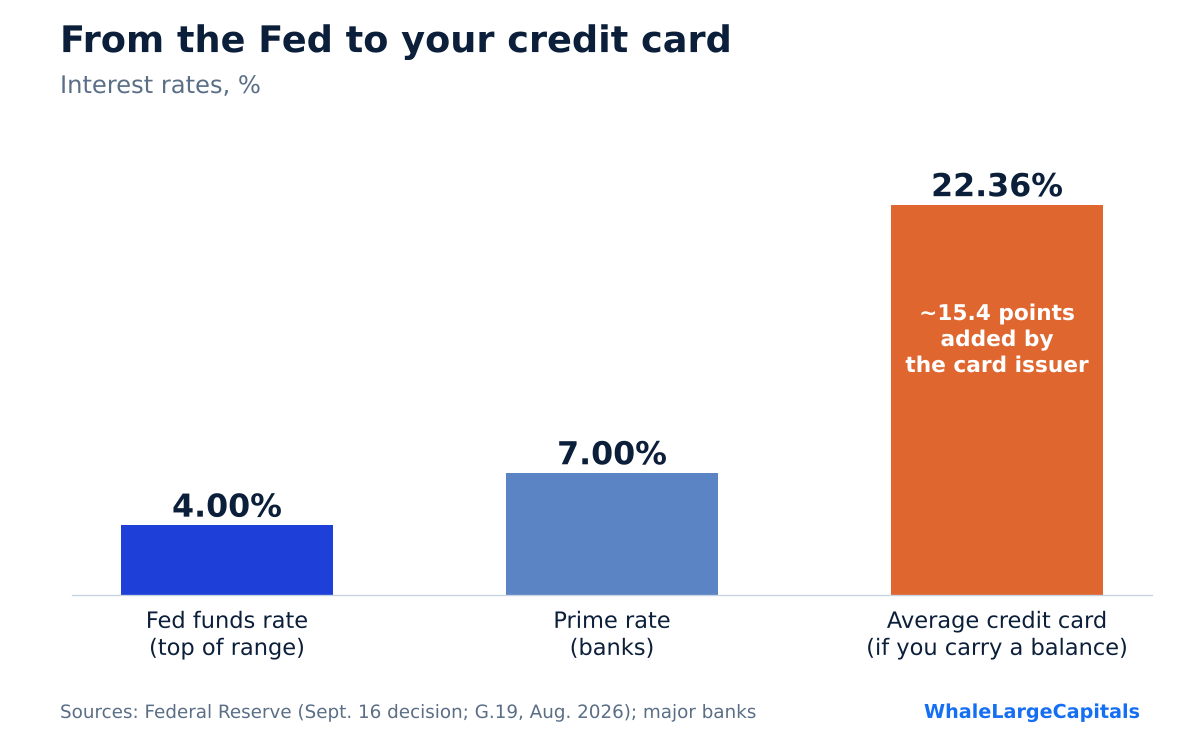
The Fed sets one rate: what banks charge each other overnight. Banks then set their prime rate, which has been 7% since September. Most credit cards charge prime plus a fixed margin that the card company chooses.

That margin is the part nobody talks about. The average rate for card accounts that pay interest was 22.36% in August, according to the Federal Reserve. That's about 15 points above prime, and it's set by your card company, not by the Fed.

Chart: interest rates: the Fed funds rate tops out at 4.00%, the banks' prime rate is 7.00%, and the average credit card rate for accounts that carry a balance is 22.36%, about 15.4 points above prime

How to read this: each bar is one step from the Fed to your statement. The first two move with Fed decisions. Most of the orange bar is the card company's margin, and it stays put no matter what the Fed does.

The Consumer Financial Protection Bureau found in its 2023 review that these margins had climbed to a record of about 14 points, and that higher margins explained roughly half the rise in card rates over a decade. The Fed gets the headlines. The margin gets the money.

Paul's rule

The Fed moves your rate by quarters. Your lender moves it by the margin. Fight the margin.

2 of 3

$25 versus $2,236

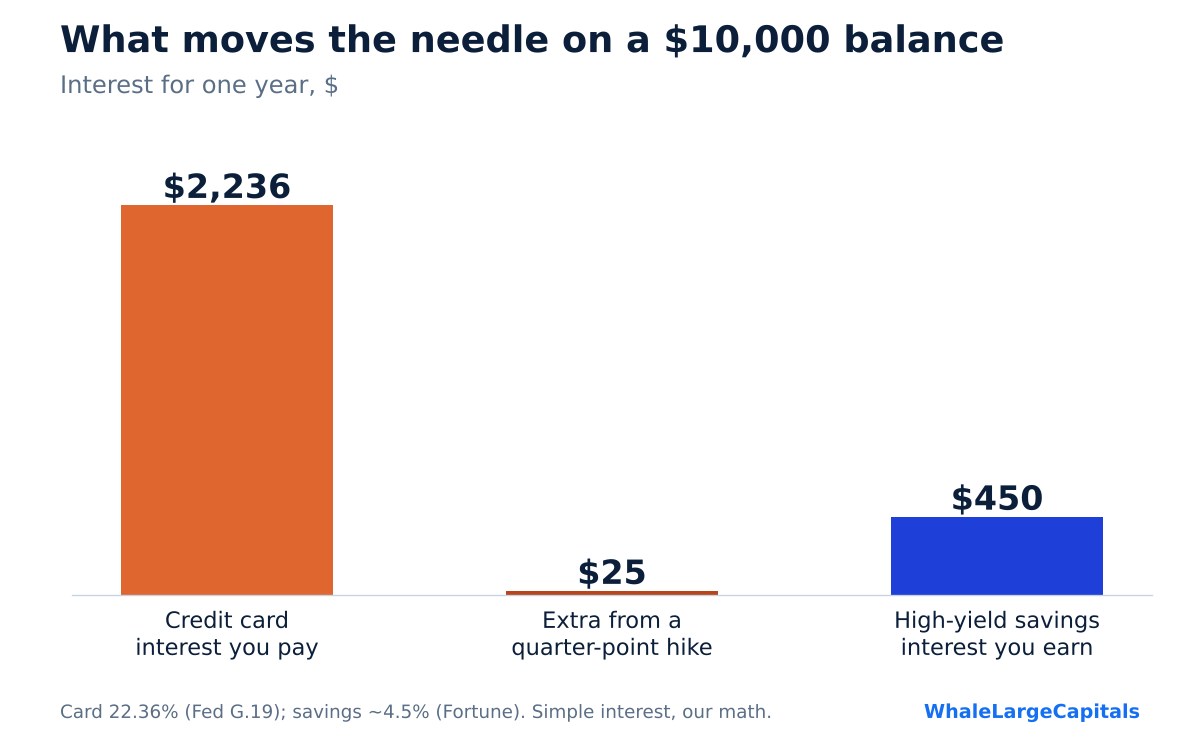
Put numbers on it. Say you carry $10,000 on a card at the average rate of 22.36%. That's about $2,236 a year in interest. If the Fed raises rates by a quarter point in December and your card follows, the extra cost is about $25.

Meanwhile, the best high-yield savings accounts were paying around 4.5% earlier this month. The same $10,000 there would earn about $450. Holding savings while carrying a card balance means paying 22% to earn 4.5%.

Chart: one year of simple interest on $10,000: $2,236 paid on a credit card at 22.36%, $25 extra from a quarter-point Fed hike, and $450 earned in high-yield savings at about 4.5%

How to read this: the tiny middle bar is what today's Fed headlines are about. The tall orange bar is what a typical balance already costs. Compounding monthly, the real cost is a bit higher still.

Paying down a 22% card balance is a guaranteed 22% return. No stock, bond or fund promises anything close. That's the single highest-return move available to most households this year.

The Fine Print

The New York Fed's quarterly household debt report shows where the pressure is building. Credit card balances reached $1.26 trillion in the second quarter. Home equity lines of credit rose $13 billion to $459 billion, $142 billion above their early-2022 low.

It also tracks how many card balances slide into serious trouble. The annualized share moving into 90-plus-day delinquency was 6.97% in the second quarter, slightly higher than a year earlier.

Read the New York Fed report

3 of 3

The variable loan hiding in your house

Credit cards aren't the only borrowing tied to prime. Home equity lines of credit usually carry variable rates that move when prime moves. For homeowners who don't want to give up a low-rate first mortgage, a HELOC is a common way to tap a house for cash, and balances have been rising.

If you have a HELOC balance, a December hike would likely raise your rate soon after. And unlike a card, the collateral is your home. If you're in your 40s or 50s and drew on a line for a renovation or tuition, now is the time to look at the rate, not after the next hike.

Test yourself: who moved up the line?

When rates stay high, the split between borrowers and lenders gets wider.

Front of the line

Card companies, which keep a margin of about 15 points above prime

Households that pay their card in full each month and pay no interest

Savers with cash in high-yield accounts and Treasury bills

Back of the line

Anyone carrying a card balance month to month

Homeowners with large variable-rate HELOC balances

People waiting for the Fed to cut before dealing with their debt

The Protocol

Four moves to make this week

1

Find your real rates. Look at the APR on every card statement and your HELOC statement. Write them in one list, highest first.

2

Call and ask. If you pay on time, ask each card company for a lower rate. It's a five-minute call, and a lower margin is worth more than any Fed cut.

3

Attack the top of the list. Send every spare dollar to the highest-rate balance first. If your emergency fund is large, consider using part of it on a 22% card.

4

Ask about a fixed rate on your HELOC. Some lenders let you lock part of a variable balance at a fixed rate. Compare it with your current rate plus a possible December hike.

Liquidation Value: getting out of expensive debt

Every escape route has a toll. Read it before you take it.

Balance transfers. Low or zero-rate offers usually charge an upfront transfer fee, and the promotional rate ends on a set date.

Using savings. Paying off a card with your emergency fund saves interest, but leaves less cushion if something goes wrong.

Moving card debt to a HELOC. The rate is lower, but you turn unsecured debt into debt backed by your home.

Credit score. Opening new accounts or closing old ones can move your score in the short term.

I'm wrong if inflation cools quickly and the Fed reverses course next year. Variable rates would then fall on their own, though the card company's margin would stay just where it is.

The Boardroom

A question I get a lot: should I pay off debt or invest?

Start with the rate. Any debt costing more than about 8% to 10% usually comes first, because paying it off is a guaranteed return the market can't promise. At 22%, it isn't close.

There's one exception: if your employer matches 401(k) contributions, put in at least enough to get the full match while you pay down the card. A match is an instant return of 50% or 100% on that money, depending on your plan. Everything above the match should go to the most expensive debt until it's gone.

That's it for this morning. Whatever the Fed says at 2 p.m., the most useful thing you can do today is find the APR on your highest-rate card. That number matters more to your finances than anything said in Washington.

Paul Haull