|
| The Morning Letter |
Thursday, October 8, 2026 |
|
Morning briefing
"Semi-liquid" has a line too. Private credit investors just found it.
By Paul Haull. 6-minute read.
|
|
Good morning.
In recent years, private credit became one of the fastest-growing products Wall Street sells to people like you: high yields, steady income, and a promise that you could get your money out every quarter. The third-quarter numbers are now in, and they show what that promise really meant. When too many people want out at once, there's a line. And the line moves slowly.
|
|
What happened
Cliffwater: investors in its $31 billion flagship fund asked to redeem about 16% of shares in the third quarter. The fund paid out 5%, roughly one dollar for every three requested.
Blackstone: requests at its flagship private credit fund ran at about 10% again. It kept its 5% quarterly limit.
Blue Owl: holders of its largest technology lending fund recently asked for 39% of their shares back.
KKR: on Monday, one of its funds said requests came in just over its limit, at 5.06%, and it will pay everyone in full.
Why: worries about loan quality and valuations, especially loans to software companies, according to Benzinga's reporting.
Read the Benzinga report
|
|
|
1 of 3
What "semi-liquid" actually means
These funds lend money directly to mid-sized private companies. Those loans don't trade on any exchange. If a fund had to sell them in a hurry, it would take a steep discount.
So the funds were built with a valve. Once a quarter, they offer to buy back a slice of their own shares, usually capped at about 5% of the fund. If requests stay under the cap, everyone gets paid. If requests go over, everyone who asked gets the same fraction, and the rest waits for next quarter.
That's not a malfunction. It's the design. Here's what it looks like when the valve is tested.
|
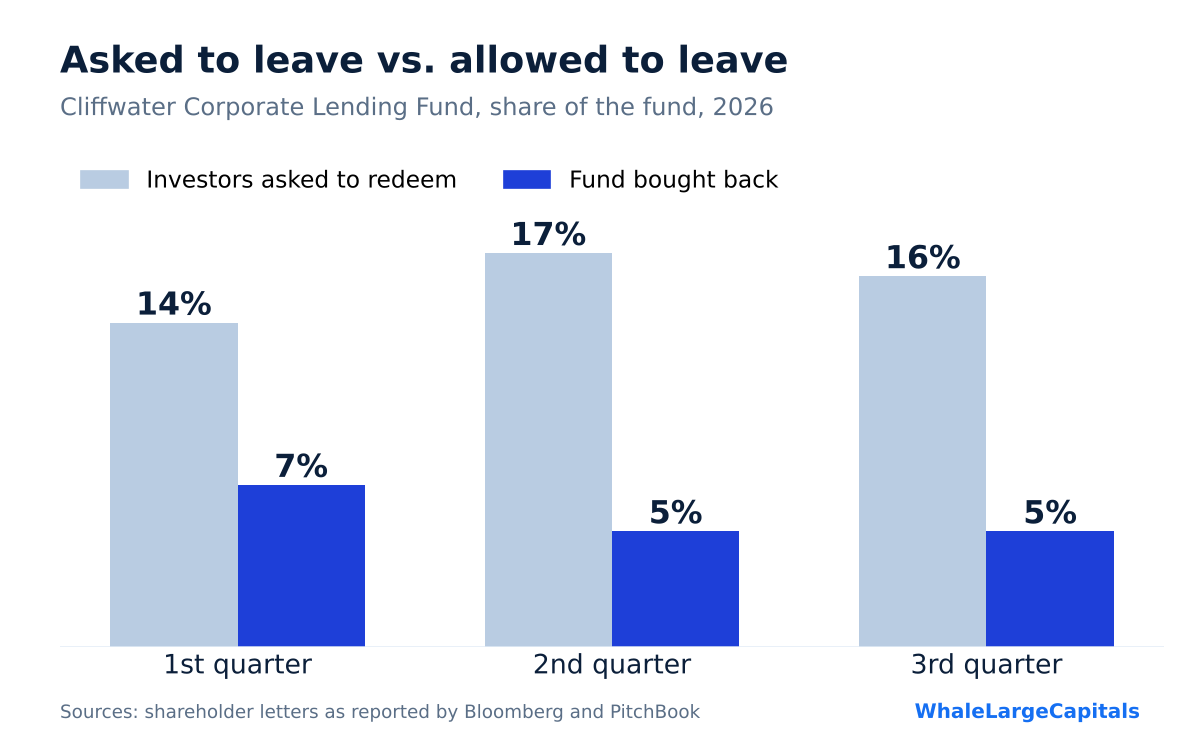
How to read this: the pale bar is how much of the fund wanted out. The dark bar is how much the fund let out. The gap is money still waiting in line.
|
|
|
Paul's rule
Liquidity is a promise that holds until everyone asks for it at once.
|
|
|
2 of 3
How long the line really is
Put a real number on it. Say you asked Cliffwater for $100,000 back at the start of the year and resubmitted every quarter. Here's roughly how your money would have come out at the fund's actual payout rates.
|
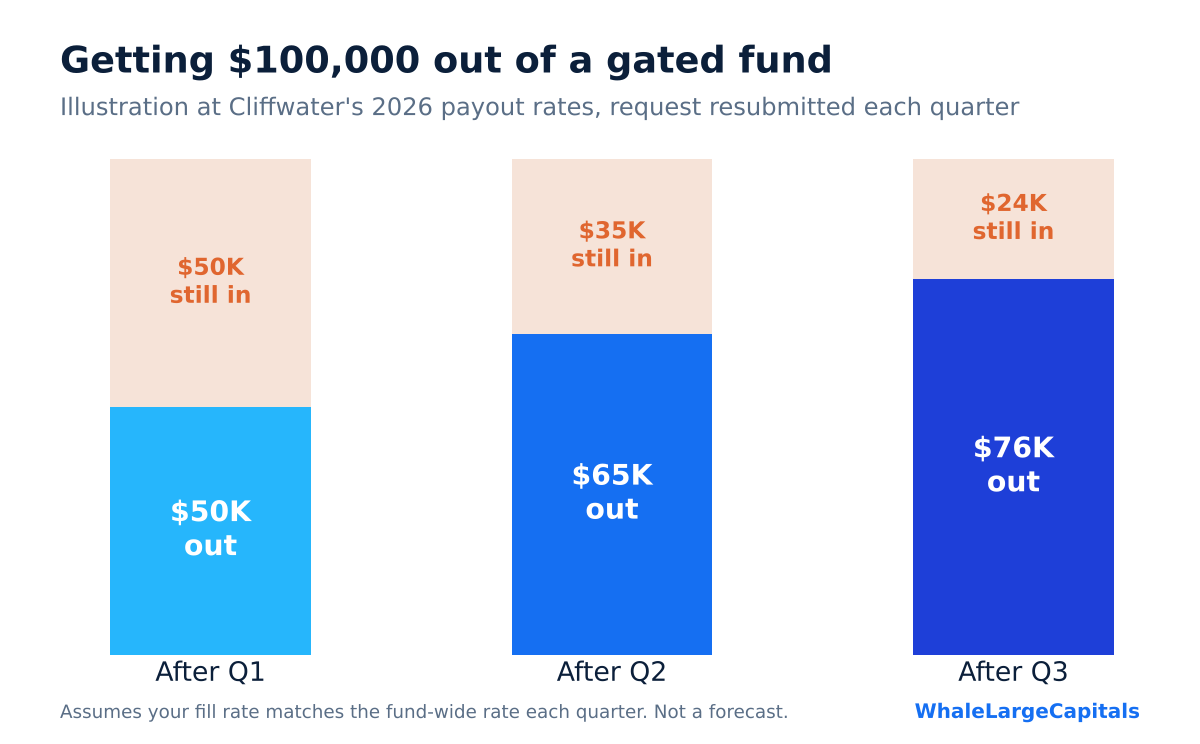
How to read this: blue is money back in your account, orange is money still in the fund. Nine months in, about a quarter is still waiting. Cliffwater itself says investors who have asked since the first quarter have received about 78% of their capital so far.
|
|
|
Notice the shape. Your first payment is the biggest; each one after is smaller, because the same fraction applies to a shrinking balance and a crowd that keeps resubmitting. You do get out. Slowly, on the fund's schedule, not yours.
None of this was hidden. The regulator spelled it out years ago.
|
|
The Fine Print
The SEC's investor bulletin on interval funds, the structure Cliffwater uses, says these funds buy back only 5% to 25% of their shares in each repurchase offer, usually quarterly. When requests exceed that, buybacks are generally done pro rata, meaning everyone gets the same fraction.
In plain words, the bulletin warns that "there is no guarantee that you can sell the number of shares you want." It also notes these funds may charge a fee of up to 2% on money you take out.
Non-traded business development companies, like Blackstone's and Blue Owl's funds, work differently on paper, but most have been holding to similar 5% quarterly limits.
Read the SEC bulletin
|
|
|
3 of 3
Who carries the risk while the line moves
In a bankruptcy, creditors of the same class are paid pro rata, and the order of the line is fixed in advance. A gated fund works the same way. Everyone who asks in the same quarter gets the same slice. Nobody jumps the queue.
The quieter question is what happens to the people who stay. To pay leavers in cash, a fund uses its cash and its easiest-to-sell loans first. Industry analysts have warned that heavy redemptions can leave remaining investors holding a portfolio that's harder to value and harder to sell.
That doesn't mean these funds are failing. KKR's fund just paid everyone in full, and managers argue the caps protect long-term holders from forced sales at bad prices. It means the product behaves like what it is: a loan portfolio you can exit only in installments.
|
Test yourself: who moved up the line?
When the exit narrows, position decides everything.
|
Front of the line
Investors who sized private credit as money they won't need for years
Funds with smaller redemption queues, which can still pay in full
Anyone who read the repurchase terms before buying
|
|
Back of the line
Retirees who treated these funds like a savings account
Investors in funds heavy with the loans now under the most doubt
Anyone who needs the full amount back by a fixed date
|
|
The Protocol
Four moves to make this week
| 1 | Find out if you own one. Look on your statements for words like "interval fund," "non-traded BDC," "private credit" or "income fund" with no ticker that trades daily. Some sit inside managed accounts you haven't looked at in a while. |
| 2 | Read the repurchase section of the prospectus. Note three things: how often the fund buys back shares, the maximum it will buy, and the deadline to submit a request. Miss the deadline and you wait another quarter. |
| 3 | Match it to your calendar. If you'll need this money for living costs, a home or required minimum distributions in the next two years, plan as if it comes out in pieces, not all at once. |
| 4 | Before buying any new fund, ask one question. "If I want all my money back on one day, how and when do I get it?" If the answer takes more than one sentence, size the position accordingly. |
|
|
Liquidation Value: a private credit fund
The yield is on the front page. The exit terms are in the back.
Speed. Usually once a quarter, and only up to the cap. When the line is long, expect installments.
Price. You sell at the fund's own valuation of loans that don't trade. You won't know the exact price when you submit.
Fees. Interval funds may deduct up to 2% from repurchase proceeds. Check for early-exit fees too.
Who stays. Heavy redemptions can leave remaining holders with a harder-to-sell portfolio.
I'm wrong if loan losses stay low and requests fade. Then patient holders keep collecting high income, and those who sold in the queue gave it up for nothing.
|
|
The Boardroom
A question I get a lot: should I join the line now?
Start with need, not fear. If you'll need the money in the next couple of years, or the position has grown too large for comfort, submitting a request each window is reasonable. Expect to get it back in pieces, and resubmit every quarter until you're done.
If you bought it as long-term income and the fund is still paying, joining a crowd at the exit can mean selling at the worst moment for no real reason. Either way, decide based on your own timeline, write the decision down, and don't let one headline make it for you.
|
|
That's it for this morning. Before you buy anything that pays more than the market, find the page that explains how you get out. That page tells you where you stand in line.
Paul Haull
|