|
| The Morning Letter |
Tuesday, October 6, 2026 |
|
Morning briefing
The diesel tax break is a deferral. Read the fine print.
By Paul Haull. 6-minute read.
|
|
Good morning.
Last night the President signed an order meant to bring down the price of diesel. The speech said "tax-free." The document says something more careful. When a speech and a document disagree, I read the document. Today I'll show you why that matters, and why diesel matters to you even if you've never filled a truck in your life.
|
|
What happened
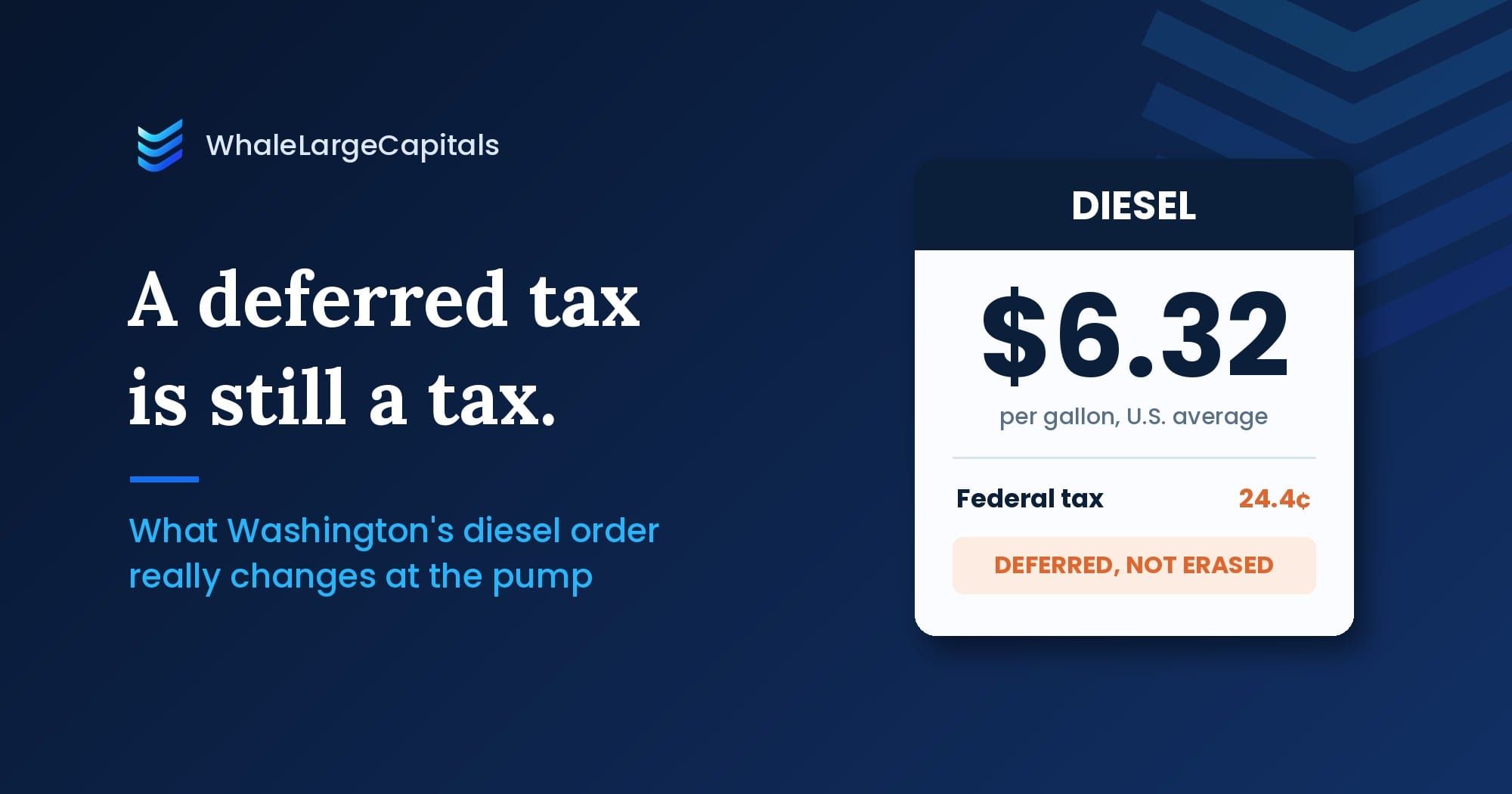
The order: red-dyed diesel, normally sold tax-free for farms, construction and home heating, may now be used on highways. The 24.4-cent federal excise tax on that fuel is deferred through the end of the year.
The price: the national average for diesel was $6.32 a gallon on Monday, according to AAA. It hit a record $6.53 on September 22, up from $3.76 before the Iran war began.
The claim: the White House says the move will save truckers more than $100 per fill-up. CNN estimates a 250-gallon fill could fall by about $150, but only if both federal and state taxes come off.
The doubt: GasBuddy's Patrick De Haan called it "not really a needle-mover," noting that truckers cross many state lines with different rules.
Read the CNN report
|
|
|
1 of 3
Diesel is the price behind every other price
Gasoline moves you. Diesel moves everything else. The trucks that stock your grocery store, the tractors that plant the crops, the trains and barges that carry them all run on it. When diesel jumps, the cost shows up a few weeks later in prices that never mention fuel at all.
Here's this year's climb.
|
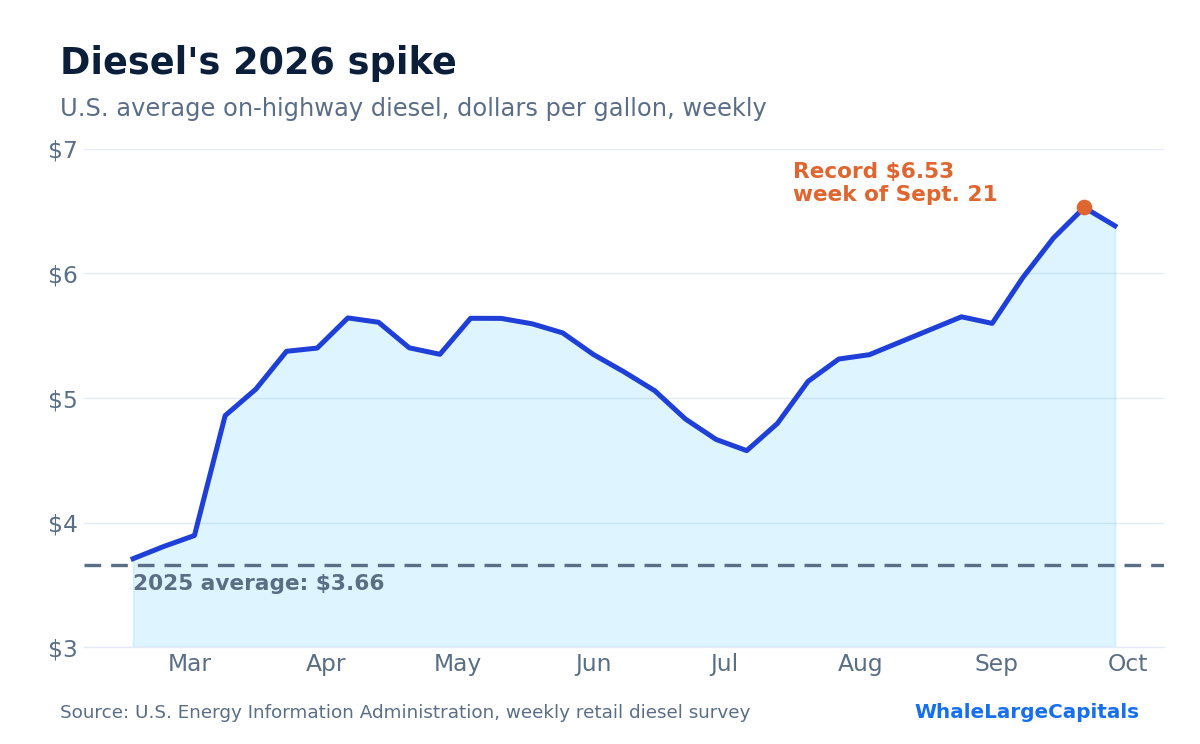
How to read this: the dashed line is what diesel cost on average last year. Everything above it is extra cost moving through the economy. The early-March jump came as the war began; the September surge came as the refinery squeeze tightened.
|
|
|
Diesel is up about 77% this year, on track for its biggest annual increase since AAA began tracking in 2000. Heating oil comes from the same part of the barrel. If you heat your home with oil, this chart is a preview of your winter.
|
|
Paul's rule
A deferred bill is still a bill. Find out whose name is on it.
|
|
|
2 of 3
Read the order, not the speech
On stage, the promise was "tax-free" diesel for anyone. The White House's own fact sheet uses a different word, and in any contract, single words are where the money hides.
|
|
The Fine Print
The fact sheet says the order tells the Treasury to defer payment of the federal excise tax on highway use of dyed diesel for the rest of the year, without interest or penalties. It then asks Treasury to explore pathways to eliminate the obligation to pay the deferred taxes.
Read those two phrases together. Today the tax is postponed, not cancelled. Whether it ever goes away depends on a decision that hasn't been made yet.
State taxes, which average 35.5 cents a gallon, are up to each state. Ten states, covering about a third of diesel sales, had already moved to widen access before the order.
Read the White House fact sheet
|
|
|
Now put the tax in proportion. Even if every tax came off, most of the price would still be standing.
|
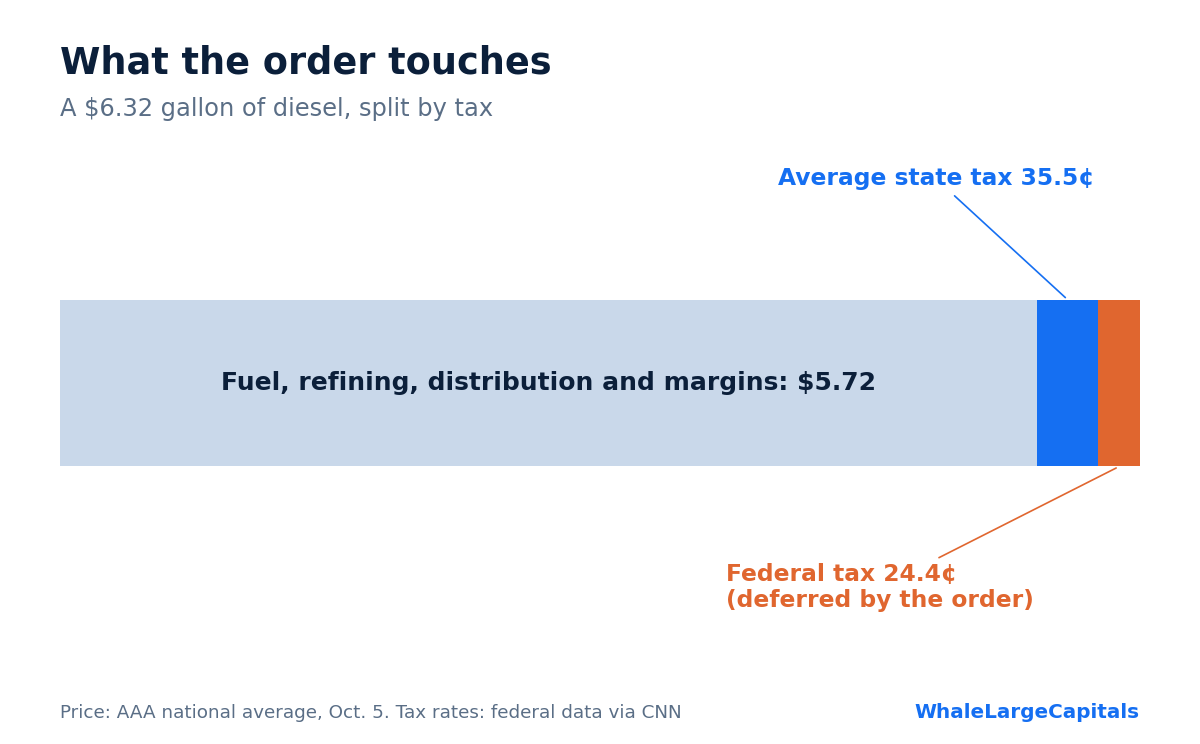
How to read this: the orange sliver is the federal tax the order defers, about 4% of the price. Add the average state tax and it's still under 10%. The big pale bar is the part no order can touch.
|
|
|
3 of 3
The real shortage is in the barrel
Taxes aren't why diesel soared. Supply is. War has damaged refineries in the Middle East and Russia, China is holding back fuel exports, and U.S. refineries are already running about as hard as they can, according to CNN's reporting.
On Monday, the head of Saudi Aramco, the world's largest oil producer, put numbers on the damage. Amin Nasser said nearly 3 billion barrels of supply have been lost since the war began, more than 1 billion barrels have been pulled from storage to fill the gap, and the world's cushion is now "scarily thin." Even after shipping through the Strait of Hormuz fully recovers, he said, rebuilding inventories could take up to two years.
That's the balance sheet that matters. A tax deferral changes who pays a sliver of the price for three months. It doesn't add a single gallon to the tank.
|
Test yourself: who moved up the line?
Every tax break moves the bill somewhere. Here's where this one lands.
|
Front of the line
Truckers and farmers who can actually get dyed diesel
Businesses in the states that also waive their own fuel taxes
Anyone who reads the order closely and plans for both outcomes
|
|
Back of the line
Users who may still owe the deferred tax next year
Households heating with oil this winter
Shoppers paying the freight cost baked into every grocery item
|
|
The Protocol
Four moves to make this week
| 1 | If you heat with oil, call your supplier now. Ask about delivery schedules and any fixed-price or budget plans for the winter. Decide before the first cold snap, not during it. |
| 2 | Check your state's rules before using dyed diesel. The federal order doesn't change state law. Rules differ from state to state, and penalties for using dyed fuel on the road can be steep where they still apply. |
| 3 | Service your backup power. If you own a diesel generator, test it now and rotate old fuel. Diesel keeps longer than gasoline, but not forever; a fuel stabilizer helps. |
| 4 | Budget for the delay. Freight costs reach store shelves with a lag. Plan for food and delivery prices to stay elevated for months, whatever happens to the tax. |
|
|
Liquidation Value: the diesel tax break
Before you count the savings, price the terms.
The amount. 24.4 cents a gallon federally. About 4% of today's price.
The status. Deferred through year-end, not forgiven. Forgiveness is still being "explored."
The coverage. State taxes come off only where states act. Access to dyed diesel varies by region.
The clock. It isn't clear how long the order will stay in effect.
I'm wrong if Treasury cancels the deferred tax and most states follow. Then truckers could save up to about 60 cents a gallon, and some of that may reach shelves.
|
|
The Boardroom
A question I get a lot: should I stock up on fuel?
A modest, rotated reserve for a generator or a long drive is sensible preparation. A garage full of fuel cans is not. Fuel ages, storage brings real fire risk, and many local codes limit how much you can keep at home. Check yours before you buy containers.
Think of it the way a company thinks about inventory: hold enough to get through a disruption, rotate it so nothing goes stale, and don't tie up cash in stock you can't safely store. The best hedge against high fuel prices is usually needing less of it, not hoarding more.
|
|
That's it for this morning. When a fix is announced on a stage, find the fact sheet. The verbs tell you who really pays.
Paul Haull
|